|
Instrument Database:
Analytik Jena GmbH - HydrEA
| |
|
|
| |
|
| |
|
| Year of introduction |
|
| Status |
available |
| Company |
Analytik Jena GmbH
|
| Categories |
Sample introduction: Vapor generator
|
|
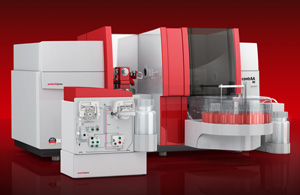
The integration of hydride and graphite furnace technique – a new dimension in analysing hydrid-forming elements There is a growing demand for measurement systems that are largely immune to interferences and have the potential for automation, while being able to detect ultra-trace levels of toxic elements. In contrast to mercury, traditional hydride systems do not offer a facility for enriching elements such as arsenic or selenium. But this very capability is becoming an increasingly relevant requirement in environmental analysis. The HydrEA technique is the answer – the unique achievement of coupling hydride generation to electrothermal atomization in a graphite tube. Combining a graphite- furnace AAS instrument with the hydride system and an autosampler opens up new avenues to automated hydride analysis. The principle is simple A carrier gas stream carries conventionally generated metal hydride into the graphite tube instead of a quartz cell. The tube, permanently pre-coated with iridium, absorbs the inflowing hydride or mercury. Subsequent steps resemble the usual procedure followed in conventional graphite tube systems. An optimized temperature-time program is run, and the data are evaluated. The advantages are obvious: Continuous and discontinuous mode available Capability to enrich hydride-forming elements in the graphite tube, plus specific atomization
|
Related links:
|